

Kathy McGee has been working at the forefront of digital fashion for the best part of a decade. Ever since a career-altering encounter in the student bar at London’s Royal College of Art, McGee has been incorporating digital tools into her design practice, probing at what’s possible with 3D scanning and computer-assisted pattern cutting in a hybrid approach to exploring alternative design processes. In her role as the founder of Digitoile, a research and design studio focused on physical-digital fashion outcomes, and as a senior lecturer on digital fashion at Central Saint Martins, McGee works to develop the new creative processes and workflows the next generation of designers are using to shape the future of fashion.
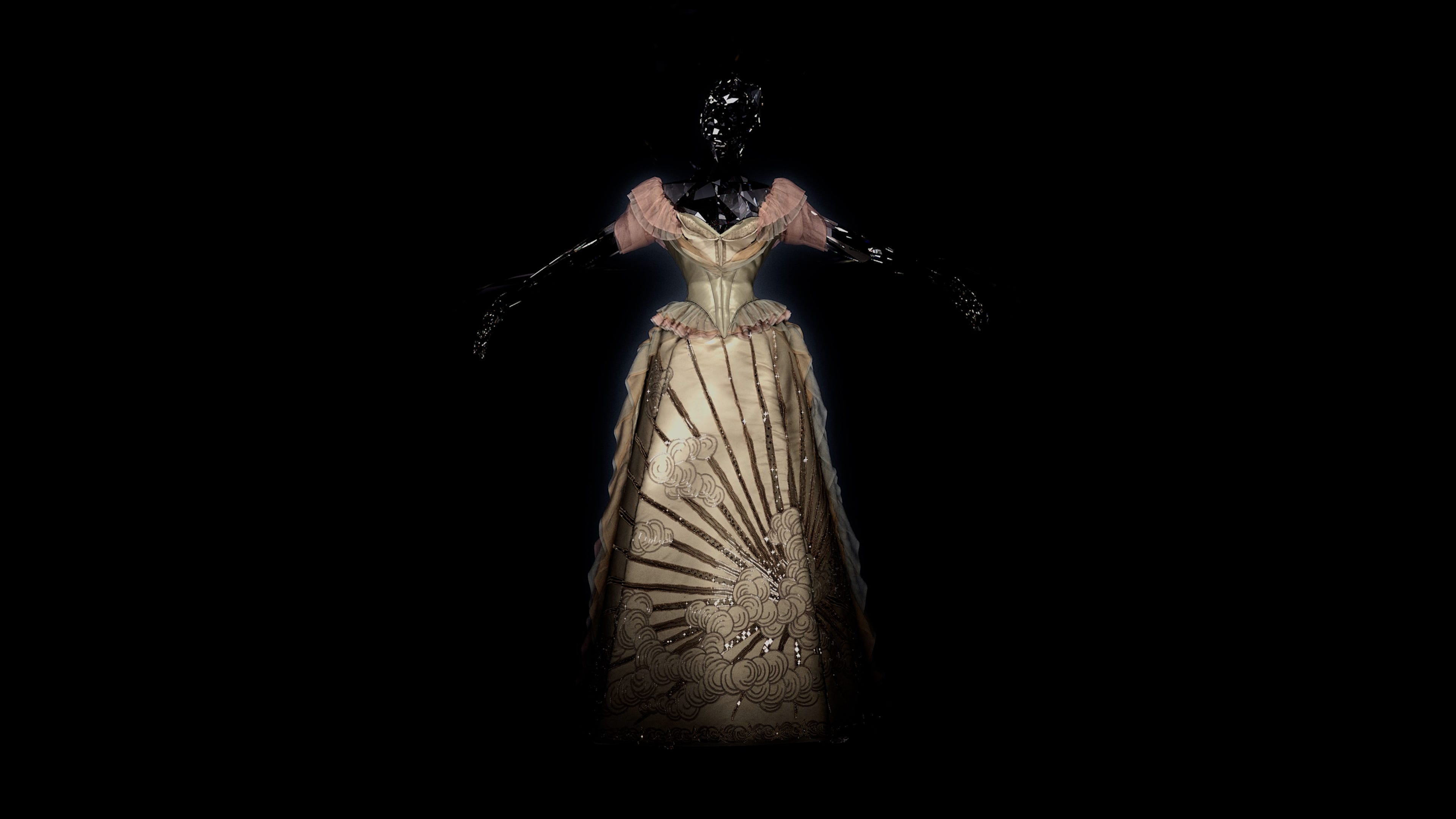
Renowned for her collaborations with designer Per Götesson, A New Plane has followed McGee’s incredible work for years, joining forces with the designer for Sleeping Beauties: Reawakening Fashion, The Costume Institute’s Spring 2024 exhibition at The Met Museum. Featuring approximately 220 garments and accessories spanning four whole centuries, the exhibition explored how digital fashion tools can be used to resuscitate the sensorial qualities of historical garments, many of which are too fragile to be worn and, in some cases, even to be displayed on a mannequin.
McGee worked in collaboration with A New Plane to both recreate and reimagine design techniques that date back hundreds of years using digital tools which, while initially developed for game design, have been adapted for use in the fashion industry. In her use of software that has existed for decades to recreate physical design techniques that date back centuries, McGee offers unique insight into the historical context of both digital and physical fashion. We sat down with the designer to talk through her approach to digital fashion design, how digital tools have changed her own design practice and how she introduces these techniques to emerging designers.
How did you first come across digital design tools and how did they change your working practice at the time?
I was very anti-digital as a designer before I was introduced to them, I would quite flatly refuse to do anything digital. At that point, in 2015, digital in fashion wasn’t even a conversation anyone was really willing to have. Whilst I was on my Masters at the Royal College of Art I was introduced to this student who was on the product design course. We just got connected in the bar, which is where most of the things at RCA happened. He had an architecture background and part of his project was developing a digital tape measure. He was really interested in how you could capture digital measurements with a physical tape measure and link that to a software where it might be able to build what you’re measuring. I’d never heard of 3D scanning or photogrammetry, I had never even thought that these things were possible. He showed me Rhino 3D and I was shocked that all of these other disciplines had been using these tools for ages.
Did you instantly see the potential of using these tools?
Completely. Even though Rhino is not necessarily a tool for cloth simulation, seeing that you could 3D scan a body, bring that into a software and build around it was exactly what I was doing physically, but way better! For the project, we used these different coloured tape lines to create our own block skeleton on my friend’s torso. I would watch him suddenly build these 3D surfaces that would have taken me ages. I started learning it myself from there. My friend who worked in game design used to run this event called Industry Workshops, where he would get all of these incredible concept artists, 3D modellers and VR artists together in one space and do loads of demos with all of these different companies. The first time I heard about CLO3D was at one of these events. They were using Marvelous Designer, but suggested that CLO3D would be really good for fashion and that I should try it out. The foundation of CLO3D was a PhD project, the founder had this obsession with cloth simulation, so that was the premise of it 20 years ago. It was very slow for the industry to adopt, but somebody from the games industry discovered it was perfect to create outfits in games, so they simplified it, stripped some things out that weren’t necessary and that became Marvelous Designer.
When you discovered this 3D software existed and the possibilities it presented, did that start to influence how you design things?
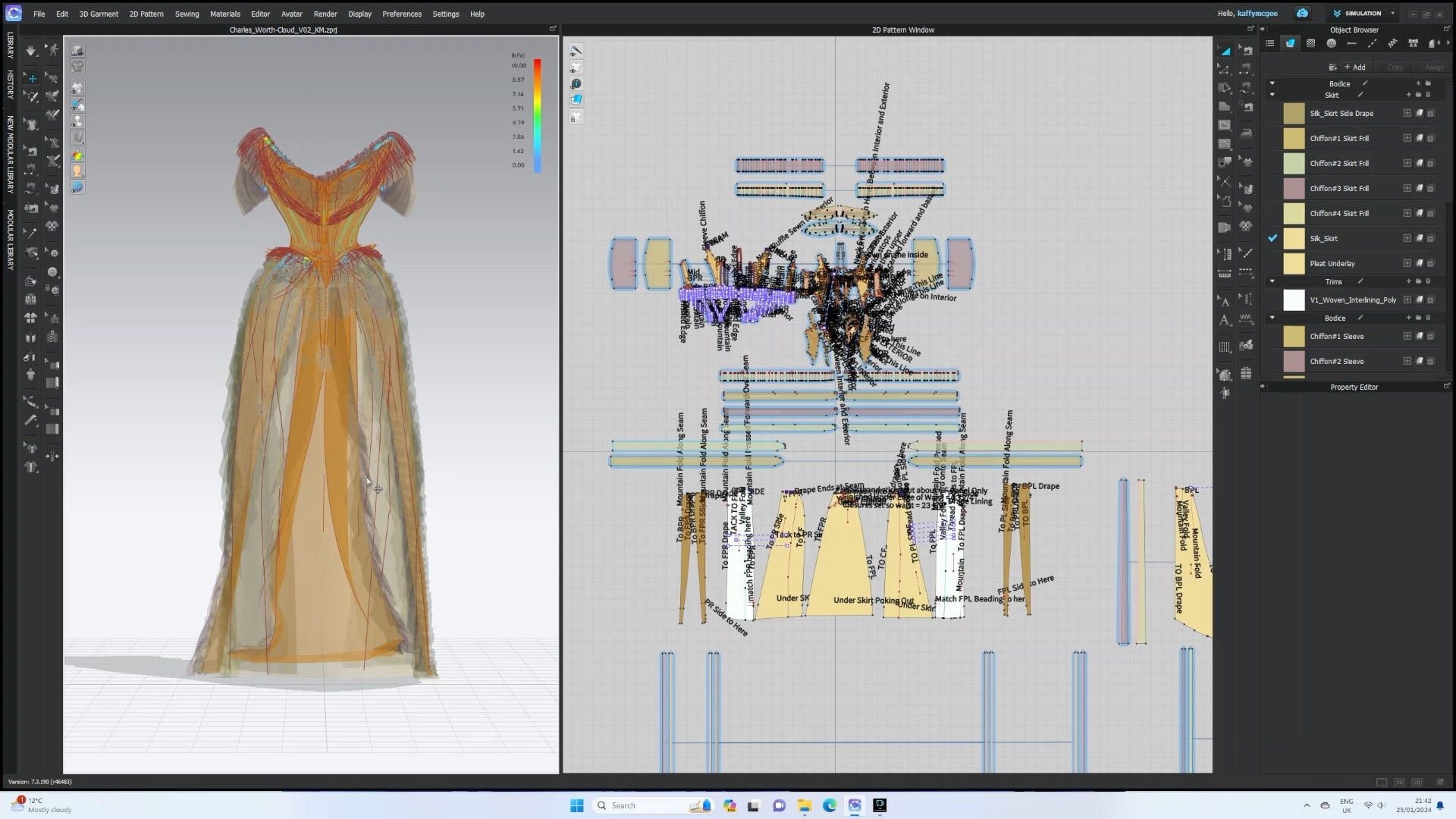
Without sounding dramatic, it basically changed the whole way that I design. I never, ever looked back. I put about two years after I graduated into just trying to teach myself all of the different softwares and understanding their limitations. I still think Rhino is a brilliant tool, but it has its drawbacks for fashion. There were a lot of inaccuracies in the patterns I made at the RCA because you’d have to flatten these really curved surfaces, so when you came to notch the patterns they wouldn’t add up and you’d have to fudge it a little bit. That’s when introducing software like CLO3D, Blender and ZBrush into the pipeline to rectify some of that was really helpful. I basically just started working with body scans all the time.
What are the primary affordances of digital-only design?
For me it’s always been about being able to explore your ideas in more unconventional ways in the early stages, especially if you’re doing something quite complex that may take you two, three, four toiles to figure out. With these tools you can do that same kind of sampling, but much faster and without having to use the raw materials to do it, so you’re able to assess your designs before you commit to physical sampling. It’s good for waste reduction, but also from a creative point of view. My colleague Margarita Louca , who’s the digital lead for the digital fashion program at Central Saint Martins, often talks about understanding the theory behind digital technologies and the way they’re changing reality. We give examples of artists and the different ways in which they’ve utilised different techniques to create different worlds and how they can start conversations from a speculative point of view, whether that’s artists and designers responding to either imagined scenarios or real political and social ideas through character, design and clothing, or the use of digital design to develop ideas previously impossible to articulate. These include artists like Lizzie Fitch and Ryan Trecartin, projects like Sportsbanger’s The Covid Letters and Lucy McRae’s Future SensitiveTM, installation works like Total Refusal’s Club Stahlbad and works of theory, like Anthony Dunne and Fiona Raby’s Speculative Everything.
How do you frame the use of these digital fashion tools to your students?
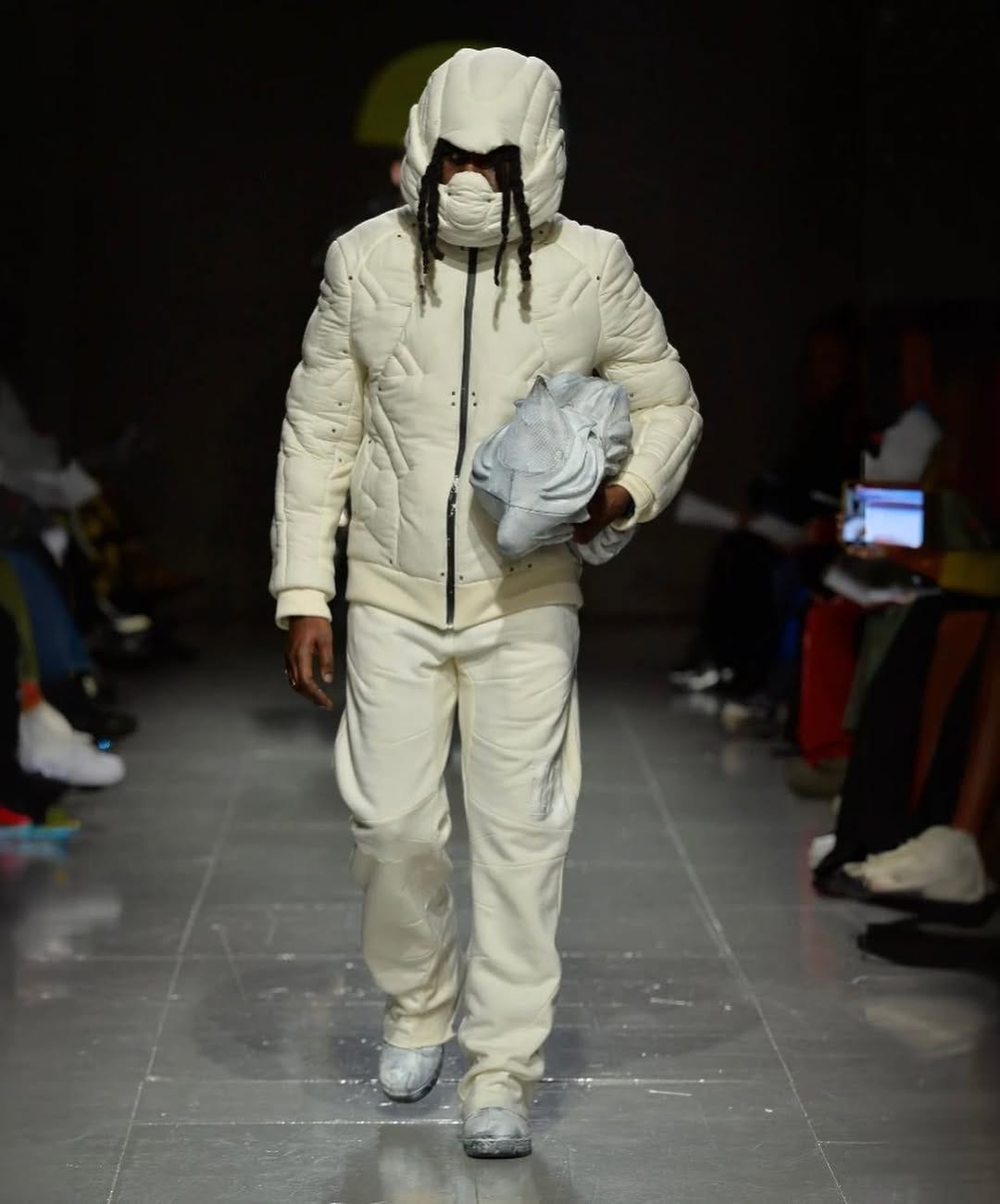
Margarita and I often start our talks by asking the students what their understanding of digital fashion is. We stipulate at the beginning that we’re not trying to sell you silver puffer jackets. In their minds that is often what digital fashion is: loads of metallic, glossy, puffed up stuff. As soon as they know that it’s not, they’re a bit more open to it. Most people that we work with at CSM, Margarita and myself included, think that there is no substance to that aesthetic. What it shows me, as somebody who has both traditional fashion skills and digital fashion skills, is one of the quickest ways you can make something look impressive. What’s really important about fashion is the storytelling ability of designers and the myriad ways that comes through in the work. There’s often whole teams of people working collaboratively to bring a shared vision to life. Even if it’s one image of a piece of clothing, it sits within this larger world and narrative that’s constantly building on this shared language with an audience.
When I look at some digital fashion, it’s being presented to me in a vacuum. A lot of the time there isn’t a body in it, so it’s void of any sense of humanity or how somebody would wear it. This has created a digital fashion aesthetic that has put lots of people off. We’ve had to do quite a lot of damage control to turn people around to understand that digital is just a tool. Your work could be about real, physical craft and working with organic materials and you could still have a digital element to the way that you work. I tend to use examples of where technology has added value to a particular output or business model, such as the shoe company Zellerfeld, a 3D-printing shoe company. Using a 3D scan of your foot, they’ve developed this 3D printing structure with a particular type of filament. I think they’ve even figured out how to 3D print a yarn, so they can actually weave sock-like structures with this filament. They’re also completely recyclable, you can break down a shoe and use it to make a new one.
Obviously we’re not expecting them to have access to those types of tools, but if they start thinking in that way they will be able to see where technology can add value to what they’re already doing. That’s how I bought into it, I could see how it was going to make what I was doing better. So whether they’re interested in technology as part of design, or even as part of communication, we remind them that digital doesn’t have to be CGI and 3D animation.
What is Digitoile? What was the impetus for setting it up and how has it transformed over the last two years?
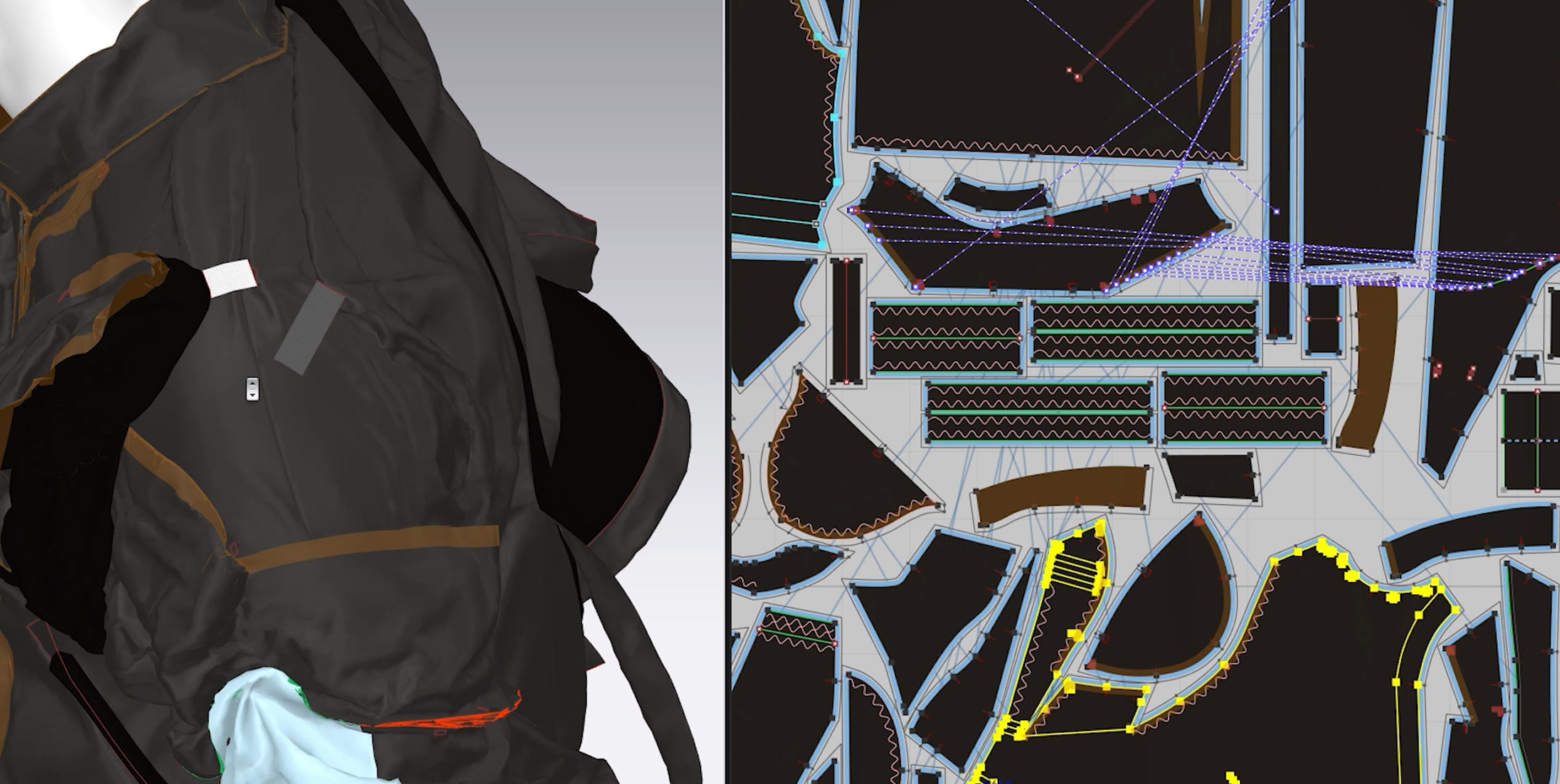
Myself and the designer Per Götesson were really interested in what digital craft might look like. What could a love of traditional craft and working with fabric look like digitally? How could a collaboration between somebody more analog and somebody more digital find different processes in that conversation? We would do these limited edition collaboration pieces, where we tried out different things, but I started to realise that the final outcome was the least interesting part to me, it was more about working with all of these different tools and design processes. I started Digitoile as a research and design studio set up to explore these tools and processes, which are not super friendly for fashion designers working with physical materials seeking a more hybrid approach, rather than a digital-first practice. It is as much about research, development and education as it is design.
My goal with Digitoile.3D is to create an easy to use, fashion focused 3D cut and unwrap tool. The unwrapping of topology to get a 2D pattern as a vector file, as opposed to a stretched image, is probably one of the most difficult things to solve in 3D modelling. With Digitoile, you could have a 3D model, draw lines on it and unwrap that, or cut that up, as an immediate 2D vector pattern. Somebody can just scan whatever they are working on and then unroll it. We want it to be as intuitive and easy to use as an app like Polycam, which I think is a great example of an accessible technology. Ultimately, I hope it enables people to be aware of possible waste right at the beginning of the process and begin to address those challenges creatively.
Our long term hope is that by focusing on hybrid design applications and functions with specific tools, these apps can be included as part of a toolkit, rather than dense, comprehensive software that needs an expensive workstation, multiple costly licenses post graduation and lots of time to learn. There is a place for big software packages in more advanced design systems, but not everyone needs this to engage. For me, it is important to make entry level applications where the learning curve does not hinder experimentation in the early stages of the digital design process.
Is this where you draw your definition of digital craft? Is it a synthesis of physical manufacturing processes and digital design?
I think so. It’s really hard to innovate within the system of more traditional fashion because none of the other parts are changing with you. You can come up with these different ways of doing things, an alternative kind of practice that might reduce a bit of waste here, or do something here, but then you have to revert back to very conventional cut and sew techniques which are quite wasteful. What is the point if I still have to fit within this model? I obviously love the process of creation and to see the end result, but for my own research and practice it’s definitely about the tooling. What tool would be useful there? How could you develop something to cut the waste there? Even looking at collaborative robotics, I’m really interested in the hardware as well as the software. It’s about how these tools can be useful to actually change the way that we approach fashion. I almost see the fact that it also enables you to create these really fascinating CGI worlds as a byproduct.
Can you say a little bit more about the hardware integration of these digital tools?
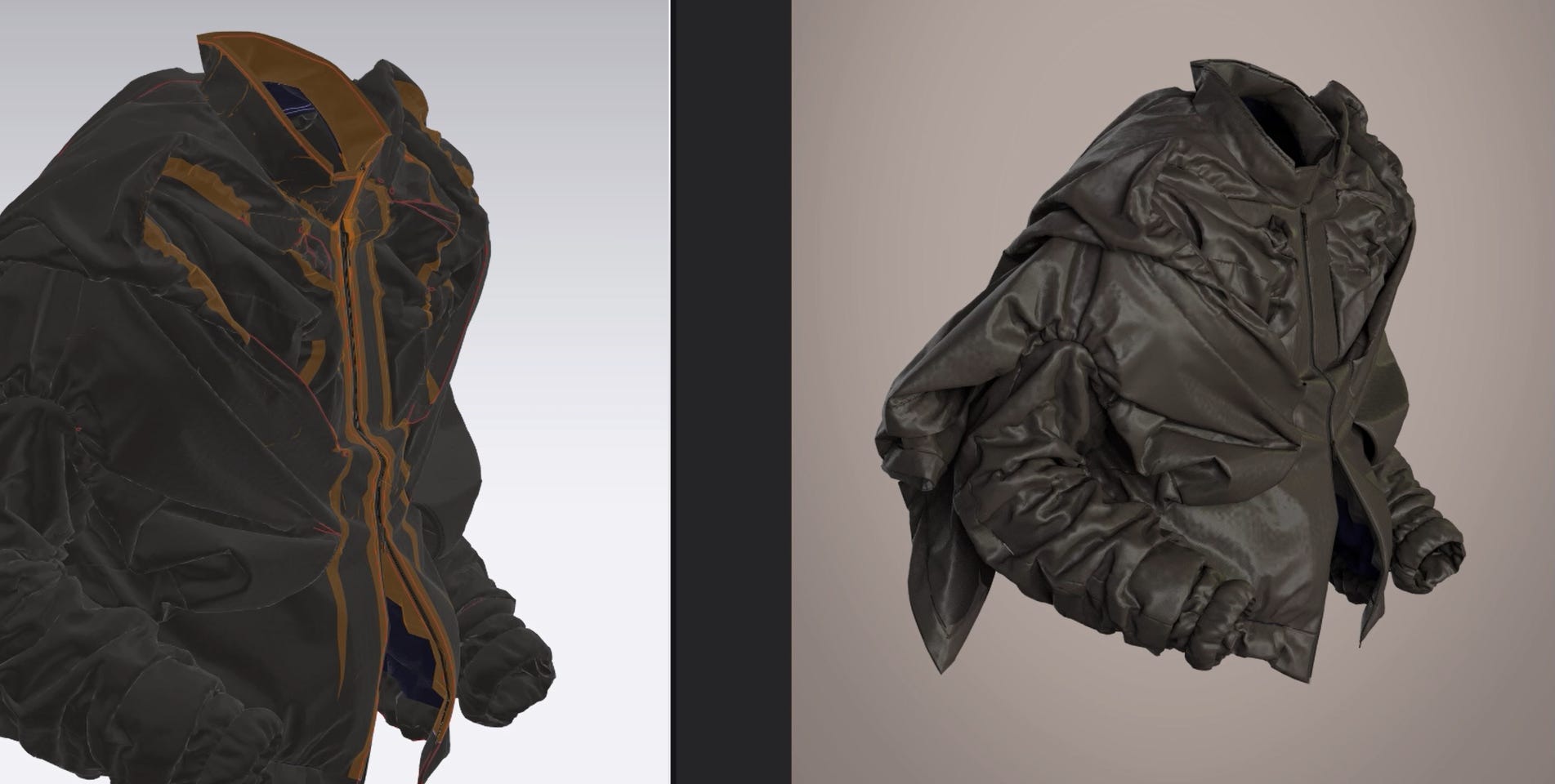
My research mentor Susan Postlethwaite, who was one of the academic leads on my project with Future Fashion Factory, is the director of the Robotics Living Lab at Manchester Met. Their research is looking at how to reshore UK manufacturing, which has been pretty much decimated, even pre-COVID and Brexit. It’s actually really difficult for independent brands to survive and be able to produce here, so I'm interested in how we can support brands doing various different things. A lot of the time this technology is already out there, it’s just that it’s being used in another discipline. Both architecture and car design seem to be quite far ahead in terms of how they’ve engaged with automation, so how might we learn to take some of those principles and make them creative in their application. If you could get these various softwares to link up to these collaborative robots, you’d be working together in this human-computer collaboration. The human would still very much be at the heart of everything that’s happening, but you could have all of these other elements that support your practice. It’s a very exciting possibility for the future.
Pair that with incoming domestic applications of AI, which will make very complicated software extremely user friendly, and you suddenly have real potential for a great unlocking of creativity
Also, alongside that, being able to use AI to actually just create your own bespoke tool for a particular project. Let’s say you just really want to be able to do this one thing, but might not be something that you need to use again, AI could make it really easy for you to develop that within an existing application. Then it's like another element of your creativity as a designer, to be able to actually write your own tools. That really levels the playing field in terms of how people can engage in more responsible fashion practices using technology.
Are any of your students exploring ways of integrating AI into your workflows?
A lot of the students use it as part of their design process. Generative online AI models can help them visualise certain things they otherwise couldn’t find a reference for. Whilst the generative stuff is fine, students are encouraged to think about the ethical implications of generative models. We can’t tell them to not do it, but we also can’t promote that as a way of working. What we try to tell them is, if you really want to work in this way, go and find someone to collaborate with to build your own machine learning model. A couple of years ago a student on the MA, Maxime Black, did that, his whole project was called Conversation With A Machine. He did a lot of styling exercises, took loads of pictures, fed them in, and it started to spit stuff back out. His challenge was to try to interpret what the machine learning model had tried to interpret from him, so it gave some really interesting solutions to different moulding techniques, different fabrications - all physical output. We try to use examples like that, if it’s something you're interested in, actually invest in building your own custom model.
On the industry side, are you seeing demand for people with skills in CLO3D and AI?
I hear from the two tutors responsible for our students’ year in industry that a lot of companies are coming back requesting students with digital skills. For them, those are the skills that they don’t have, so they want people coming to work with them to fill those gaps, from small companies right up to luxury brands. I was speaking to someone from CLO3D who was saying that their industry partners want to adopt these methods, but cannot find the talent to come and do it. So there’s a gap at the moment, it’s a case of trying to remind the students that, in an industry where it’s already hard to get a job, you may as well add this string to your bow. Zellerfeld has done collaborations with Louis Vuitton, the head of footwear at Louis Vuitton has worked with them quite a lot on developing different styles of shoes, so that maybe shows you the kind of direction that they’re wanting to go in.
Considering all the speculation that happened during COVID-19 around metaverses and NFTs, what are your thoughts on where that’s all going?
I was never really that interested in the metaverse, even as someone who enjoys playing games now and again. What I really enjoy about the skins in games is that you have to earn them through tasks. I know some people really love to spend ages dressing themselves up and doing their own thing, but I would like to earn my gear through a particular fight. I’m not that interested in bringing something from this game over into that game to wear. It doesn’t make sense in that context and I didn’t earn it, so I've got no interest. The metaverse thing just didn't appeal to me that much, I've never quite fully figured out how I feel about it.
There’s been such an evolution of terms. The ways in which people used to talk about architecture and clothing in “the metaverse”, as well as the ability to strip away the constraints of physics, seemed to ignite something in a lot of people. Now, we seem to have moved on from that.
I can definitely see why people like that part of it, as it can be very visually interesting. For me, it’s the process. Even working on Sleeping Beauties, uncovering new ways of designing and pattern cutting, you almost end up collaborating with the software because you have to find a new way to do something. The tools that you’re using impart a little bit of their own flavour. It hasn’t totally picked up on what it is you’re trying to do, so you end up getting something new that you didn’t expect. I quite like the lack of control that you have over something digitally. On the flip side, that can be really annoying if you are trying to recreate something quite specific.
How did you find working on Sleeping Beauties: Reawakening Fashion for The Met?
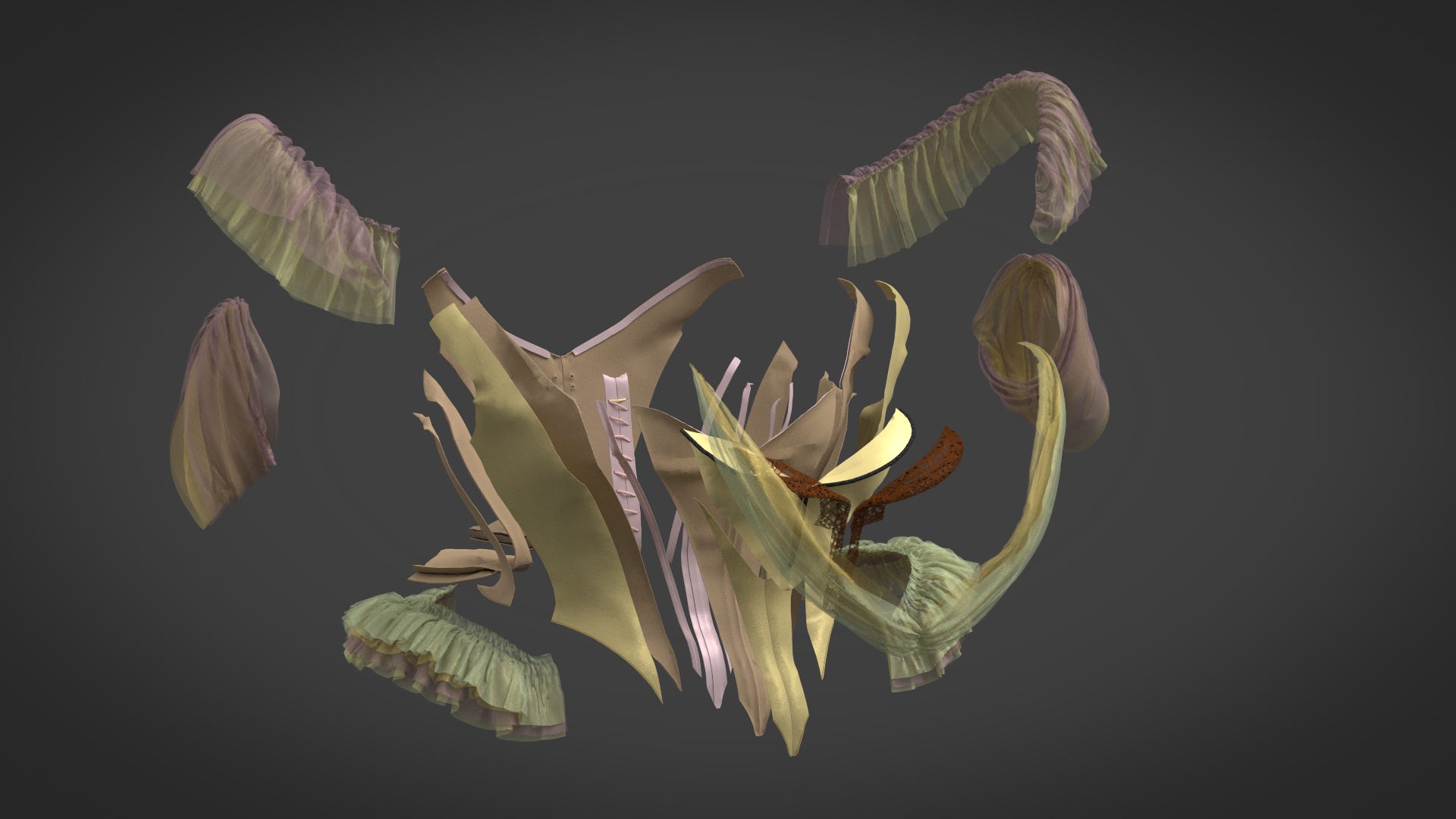
I was surprised at how much I loved doing it and how much I learnt from it! The creativity was different, it wasn’t how I had really worked before. You can’t always fully recreate how clothes would have been made physically because the software just doesn’t allow for that, so all of that problem solving that we had to do, having to come up with all of these new workarounds to get the right effect, was frustrating, but really fascinating. I would never have learnt all of that stuff without being presented with such a challenge. Even when you see those items of clothing when they are on a mannequin, you never really know what’s gone on to create that shape. There’s always an element of mystery for me. Just understanding all of the layers, what’s gone into holding certain folds and pleats in place, was sometimes knowledge about physical construction that I didn’t have before. It’s obvious that a lot of work has gone into those clothes, but you don’t fully appreciate it until you have to dissect everything about a particular dress.
Did the experience change your relationship with the archive?
I think we should be working with archives, it’s such an important part of developing digital craft. Understanding the nuances of physical techniques and then figuring out the different digital techniques to recreate them pushes digital design forward. It’s not the same, you always have to create new ones, which expands digital craft as its own practice and allows it to evolve in its own way.
Interview by Henry Bruce Jones, Róisín McVeigh and Tom Wandrag.